 Book now
 The History of the Arena di Verona
From a 1st-century gladiatorial arena to a monument still in use nearly two thousand years later — the story of Verona's Roman amphitheatre.
The Arena di Verona is one of the best-preserved Roman amphitheatres in the world and the defining monument of a UNESCO World Heritage city. Built around 30 AD, it has survived earthquakes, changing uses, and nearly two thousand years to remain not a ruin but a working venue. This guide sets out its history and the facts most visitors want to know: when and how it was built, what it was used for, what the 1117 earthquake destroyed, and why it still fills with audiences today.
Building the Arena, around 30 AD
The Arena was built around 30 AD, in the 1st century, when Verona was a prosperous Roman colony on the trade routes of northern Italy. It was raised just outside the original city walls — the usual Roman practice for large public buildings that drew crowds. In 265 AD the emperor Gallienus extended the walls, and the amphitheatre was brought inside the city it has anchored ever since. It was built from the pink-and-white limestone of the Valpolicella hills, and the resulting two-tone stonework, called dichromatism, is one of the monument's signatures.
The elliptical structure could seat roughly 30,000 spectators. That scale makes it the third-largest surviving Roman amphitheatre, behind only the Colosseum in Rome and the amphitheatre at ancient Capua near Naples. Its purpose was public spectacle — above all the gladiatorial contests that were the mass entertainment of the Roman world.
The 1117 Earthquake and the Ala
The Arena originally had a tall outer ring, a third monumental facade of arches that enclosed the whole building. On 3 January 1117 an exceptionally strong earthquake struck the region and destroyed almost all of it. The fragment that survives — just four arches, known as the Ala, Italian for 'wing' — is the only remaining evidence of that outer facade, and it still rises above the surrounding stonework on one side of the monument.
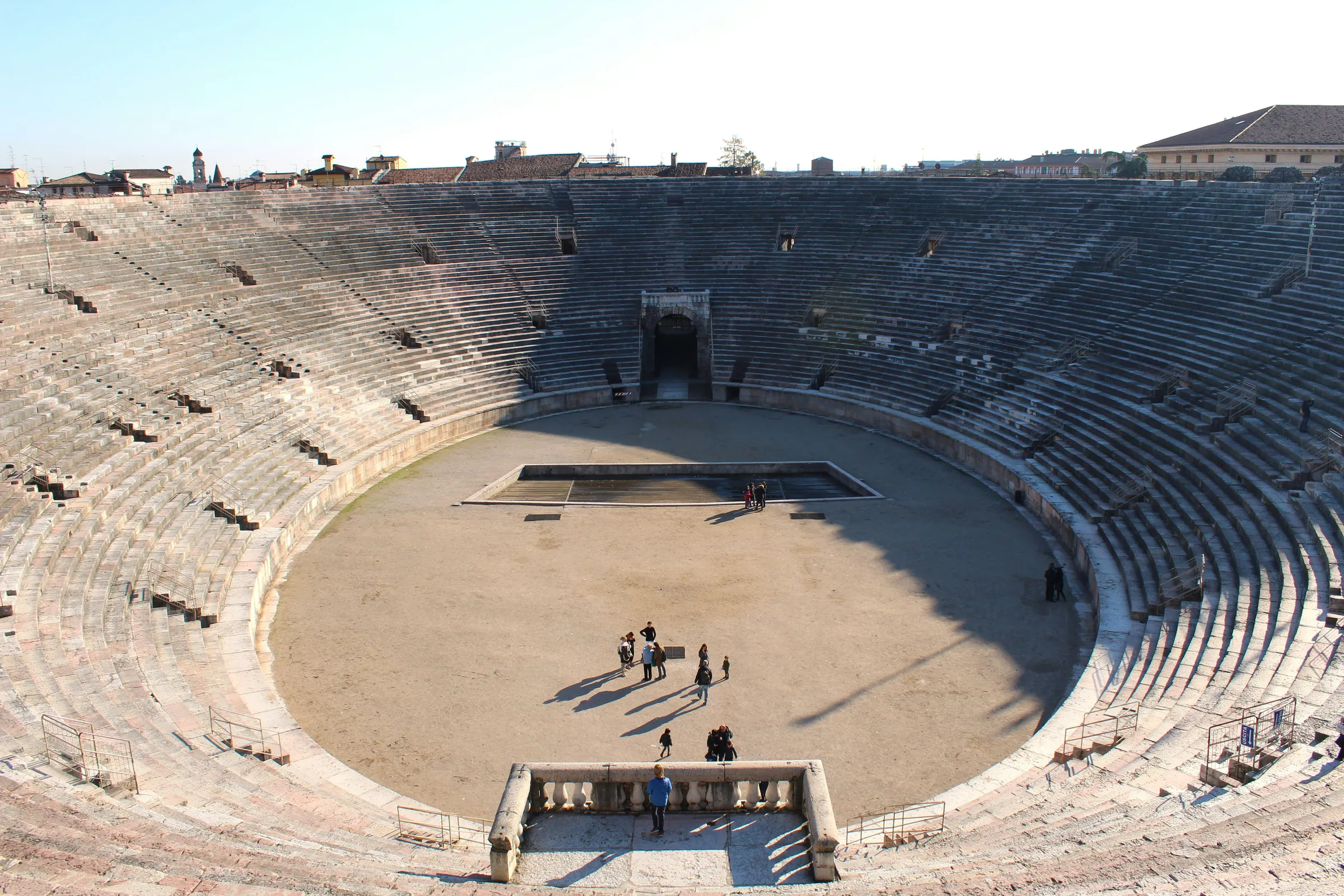
Crucially, the damage was concentrated on the outer ring. The inner ring of arches and the tiered seating survived largely intact, which is why the Arena reads today as a complete amphitheatre rather than a ruin. It is precisely this survival of the interior that makes it one of the best-preserved Roman amphitheatres anywhere.
Continuous Use — From Gladiators to Opera
What sets the Arena apart from most Roman amphitheatres is that it never fell out of use. After the era of gladiatorial games, the medieval city held jousts and tournaments in the arena, and later it was used to display exotic animals and stage public events. Its vast tiered seating and natural acoustics kept it useful long after the Roman world had gone.
Since 1913 the Arena has hosted a celebrated summer opera festival, and it remains one of the world's great open-air venues. This continuity is central to its character: a visitor standing on the arena floor today occupies a space that has drawn audiences, in one form or another, for nearly two thousand years. It is also why a daytime monument visit differs from the festival — during the summer the floor carries a stage, while out of season it is the bare Roman arena.
The Arena and UNESCO World Heritage Verona
The City of Verona was inscribed on the UNESCO World Heritage List in 2000, recognised as an outstanding example of a town that developed continuously over two thousand years, carrying artistic achievements of the highest quality from Roman, medieval, and Renaissance periods. The Arena is the centrepiece of that Roman layer and the city's single most recognisable monument.
Verona's Roman heritage extends beyond the Arena — the Roman Theatre across the river Adige, the Ponte Pietra bridge, and the street plan of the historic centre all trace back to the Roman city — but it is the amphitheatre, still standing full-height in Piazza Bra, that anchors the inscription and draws visitors from around the world.
Frequently asked
When was the Arena di Verona built?
Around 30 AD, in the 1st century, when Verona was a Roman colony. It is older than the Colosseum in Rome, which was completed around 80 AD.
How many people did the Arena hold?
Roughly 30,000 spectators in Roman times. It is the third-largest surviving Roman amphitheatre, after the Colosseum and the amphitheatre at ancient Capua.
What was the Arena used for?
Originally gladiatorial contests and public spectacle. In the Middle Ages it hosted jousts and tournaments, and later animal displays; since 1913 it has hosted a summer opera festival.
What did the 1117 earthquake destroy?
Almost the entire outer ring of the amphitheatre. The four-arch Ala is the only surviving fragment of that original outer facade; the inner structure and seating survived largely intact.
What is the Arena made of?
Pink-and-white limestone from the Valpolicella hills near Verona. The two-tone effect is called dichromatism.
Is the Arena a UNESCO World Heritage Site?
The City of Verona was inscribed as a UNESCO World Heritage Site in 2000, and the Arena is its defining monument.