 Book now
 The Arena di Verona Seating Guide
What the stone tiers are actually like to sit and climb on, why a cushion is worth it, and where the views are best during a daytime visit.
The seating inside the Arena di Verona is not a museum reconstruction — it is the original Roman stonework, worn smooth by roughly two thousand years of use. That makes it one of the most striking things about a daytime visit, and also the thing most likely to catch first-time visitors off guard: there are no cushioned seats, no numbered rows for a daytime ticket, and the steps are steeper and more uneven than they look in photographs. This guide covers what the stone tiers are actually like to sit and climb on, whether it is worth renting a cushion, and where the best sightlines are once you are up there.
The Cavea: Roman Stone Tiers, Not Museum Seating
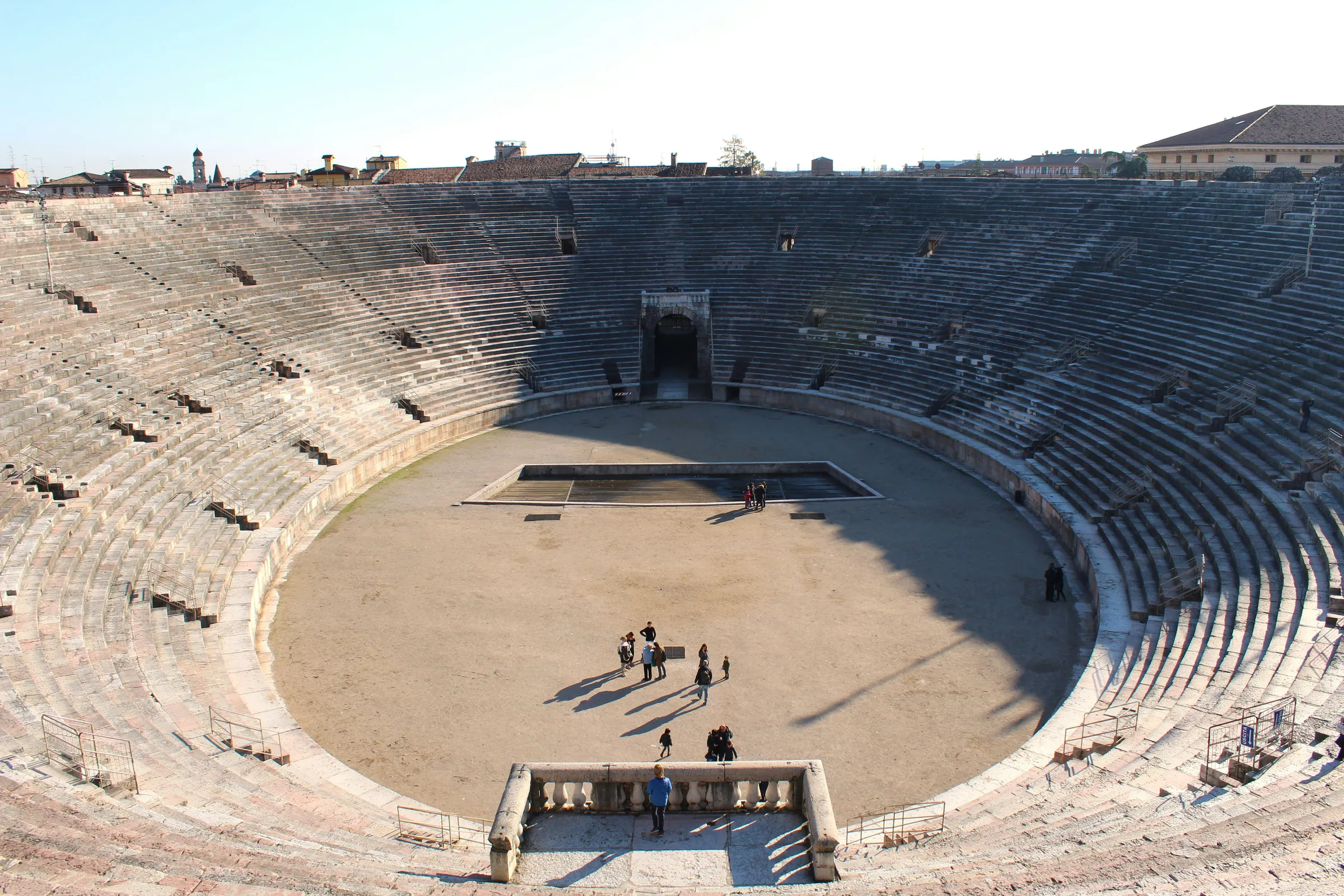
The ring of seating inside the Arena is called the cavea, and on a daytime visit you experience it exactly as it is: bare stone steps rising in tiers around the elliptical arena floor, not a modern grandstand. The steps were originally divided into wedge-shaped sections separated by staircases, and one surviving inscription on a step still reads out its own address in the numbering system — wedge, step, and seat — a small reminder that this stonework was designed to seat a specific, counted crowd in Roman times.
The stone has been repaired and reinforced over the centuries — sections of the lower access staircases and cracks between steps were restored in the 1950s, and a railing was added along the topmost step in 1960 to stop anyone stepping off the back — but the tiers themselves are the genuine Roman and medieval fabric, not a replica. That authenticity is exactly why the steps feel narrower, steeper, and more uneven than a modern venue: there is no ergonomic design here, only stone shaped by age.
Should You Rent a Cushion?
Sitting directly on the stone tiers is uncomfortable within a few minutes — the steps are narrow, hard, and unpadded, with none of the seat depth of a modern amphitheatre. Small cushion-rental stalls typically operate near the entrance area for exactly this reason, and most visitors who plan to sit for any length of time, rather than just walk through, find one worth having. Since stall pricing is set locally and can vary, treat it as a small on-site cash purchase rather than something to prebook — it is not part of any ticket.
If you are only walking the tiers to reach a viewpoint and moving on, a cushion is unnecessary. It becomes worthwhile if you plan to sit and take in the scale of the amphitheatre for a while, which many visitors do once they reach the upper rows and realise how good the view is.
Climbing the Tiers: What to Expect Underfoot
The steps rise in a continuous ring, broken by the staircases that separate the wedge-shaped sections; those staircases are the easiest route up, since the horizontal steps themselves are shallow and were never meant as a walking path. Expect uneven surfaces, some polish from centuries of foot traffic, and no handrail except the single iron rail added along the very top step in 1960. Flat, closed shoes with grip make a real difference — the stone can be slippery when worn smooth, and sandals or heels are a poor choice here.
Today's usable seating area holds around 22,000 people, noticeably less than the roughly 30,000 the complete Roman cavea could seat, because the topmost tier and outer portico that once existed no longer survive above the current rows. Visitors with limited mobility should note there is no lift to the upper levels — the operator's assisted route across the arena floor is the accessible option; see the accessibility notes in our daytime visit guide for how to arrange it in advance.
Where the Best Views Are
The upper rows of the cavea give the most complete view: the whole elliptical arena floor spread out below, the full ring of stone tiers opposite, and — turning outward — the rooftops of Verona and Piazza Bra beyond the rim. It is also the best vantage point to see the surviving Ala, the four-arch fragment of the original outer ring, standing clear of the surrounding stonework on one side of the amphitheatre.
Lower tiers, closer to the arena floor, put you at eye level with the scale of the stonework and the arches beneath the seating rather than the panorama above it — a different but equally worthwhile perspective. There is no fixed route on a daytime visit, so most visitors climb partway, pause, and choose a side depending on where the light and the view work best at the time of day they arrive.
Frequently asked
Are the seats at the Arena di Verona cushioned?
No, not on a daytime visit. The tiers are the original bare stone steps of the Roman cavea. Small cushion-rental stalls typically operate near the entrance for visitors who plan to sit for a while.
Is there numbered seating on a daytime ticket?
No. A daytime ticket is general admission to the amphitheatre — you can sit or climb anywhere on the open stone tiers. Numbered seating applies to ticketed evening opera performances, not daytime visits.
Are the stone steps steep or difficult to climb?
They are steeper and more uneven than they appear in photographs, worn smooth by centuries of use, with no handrail except a single iron rail along the very top step added in 1960. Flat, closed shoes with good grip are recommended.
How many people can the Arena's seating hold today?
Around 22,000 today, compared with the roughly 30,000 the complete Roman cavea could seat — the topmost tier and the original outer portico no longer survive above the current rows.
Where is the best place to sit or stand for photos?
The upper tiers give the widest view — the full arena floor, the opposite ring of seating, and Verona's rooftops beyond. The upper rows are also the best vantage point for seeing the surviving Ala fragment from a distance.